
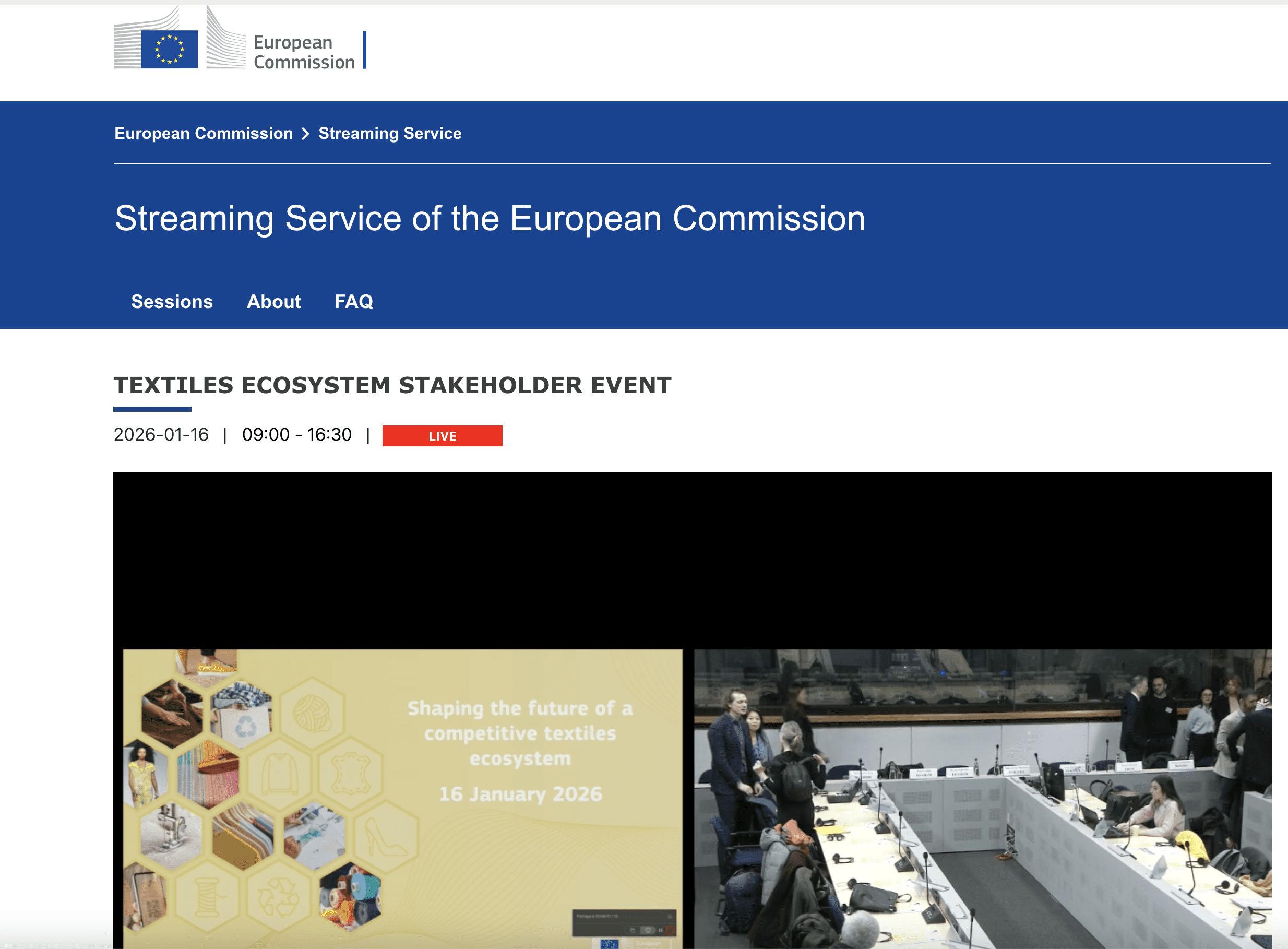
POC partner, The Federation of Sports and Play Association, was invited to attend the Textiles Ecosystem Stakeholder Event convened by the European Commission on Friday 16 January. A deliberate signal that Europe’s textile transition must reflect the full breadth of the ecosystem, not fashion alone.
By Helena Mansell-Stopher, founder and CEO, Products of Change.
Sporting goods, performance apparel, footwear, and technical products sit at the intersection of durability, safety, innovation, and sustainability. Their inclusion reinforced a simple truth: if policy works for products designed to perform, protect, and last, it will work for the wider market.
What followed was a day focused less on ambition, which is already clear, and more on how Europe delivers sustainability without losing competitiveness, industrial capacity, or predictability.
From the outset, the Commission framed textiles as a connected industrial ecosystem, spanning chemicals, retail, energy, health, digitalisation and sport.
This framing matters deeply for sectors like sporting goods and footwear, where products already face stringent performance and safety requirements. Increasingly, however, they are being regulated through frameworks originally designed with fashion apparel in mind.
As several speakers noted, one-size-fits-all policy risks creating unintended consequences, particularly for complex, multi-material products.
SMEs, footwear, and the reality check from industry
This reality was reinforced by the intervention from the Federation of the European Sporting Goods Industry (FESI), representing around 5,000 companies operating in Europe, 75% of which are SMEs, with a combined turnover of €81 billion.
Its message was clear: policy must be technically feasible, proportionate, and grounded in real-life scenarios.
“This is the first time we are extending ecodesign-style requirements to highly complex, non-energy-using products. We really need to get this right — because nobody wants to be revisiting everything again through another omnibus in a few years,” commented a representative from FESI.
FESI highlighted the risk of uncertainty and unpredictability if legislation is rushed without sufficient attention to feasibility, infrastructure readiness, and material availability — particularly around recycling and secondary raw materials.
“We need to focus on what really has an impact on sustainability and consumer behaviour — and test that against real-life scenarios, not theory,” said the FESI representative.
Footwear is not fashion – and policy needs to reflect that
A particularly strong point raised was the need to differentiate footwear from textiles and apparel within regulatory design, as the FESI representative explained; “Footwear and clothing are fundamentally different products, made of very different materials. We need to stop treating everything as one category.”
From performance trainers to ski boots, footwear often combines multiple polymers, rubbers, textiles, metals, and adhesives – making durability, repairability, and recycling far more complex than for garments.
The call was not to lower ambition, but to design smarter, product-appropriate rules that recognise material realities.
Competitiveness depends on simplification, not just ambition
Across the day, a recurring concern was that complexity is diverting resources away from sustainability and into compliance, particularly for SMEs.
FESI echoed earlier panel discussions by stressing that fragmentation across Member States remains one of the biggest threats to competitiveness, commenting, “Different EPR schemes, different objectives, different scopes – this is keeping companies awake at night and diverting investment from sustainability to compliance.”
Practical solutions were proposed, including:
- One-stop shops for EPR registration
- Harmonised fee structures
- No double reporting or double payments
- Aligned labelling and sorting instructions
The message was consistent with other speakers: harmonisation is not a ‘nice to have’, it is essential for investment confidence.
What the breakout sessions reinforced
The breakout sessions gave further weight to these concerns.
- Textile labelling discussions echoed the need to inform consumers without overwhelming them or fragmenting the single market
- Ecodesign sessions highlighted the importance of functionality, durability, and affordability — particularly for performance and sporting goods
- Textile waste and EPR discussions reinforced the urgency of simplifying cross-border movements and administrative systems
- Market surveillance and trade sessions underlined that enforcement is the missing link between ambition and fair competition
Across all rooms, the same conclusion surfaced: policy must work in practice, not just on paper.
What we learned – across the ecosystem
By the end of the day, several shared conclusions had crystallised:
- Sport, play, footwear, and technical products must be part of textiles policy design
- SMEs need proportionate, predictable, and simplified systems to succeed
- Footwear and apparel require differentiated regulatory approaches
- Durability, performance, and quality are sustainability outcomes
- Over-complexity risks undermining the very transition policy is trying to enable
Why this matters now
The invitation extended to the Federation of Sports and Play Associations – and the contribution from FESI – made one thing clear: Europe’s textiles transition will only succeed if it is grounded in industrial reality.
Policy built for performance, durability, and real-world use raises the bar for the entire ecosystem. Policy built without feasibility risks delay, revision, and lost trust.
Europe has the ambition. It has the innovation. It has the industry. What it now needs is coherent, enforceable, and workable policy — designed with those who must deliver it.
This event was not just a stakeholder dialogue, it was a test of whether Europe can move from good intentions to good implementation.