
At Marlish Waters, even the run-off water used to rinse down the cans goes back to the land. That water will spend the next 150 years seeping through the soil and rocks to find its way back to the fault line upon which cousins Joe and Elizabeth have built their business.
It was a staggering stroke of luck that put them where they are now – a burgeoning independent drinks business found among the Northumberland hills of Morpeth that turned the tragedy of foot and mouth into the opportunity to not only diversify but pioneer in a market known for being ruthlessly competitive.
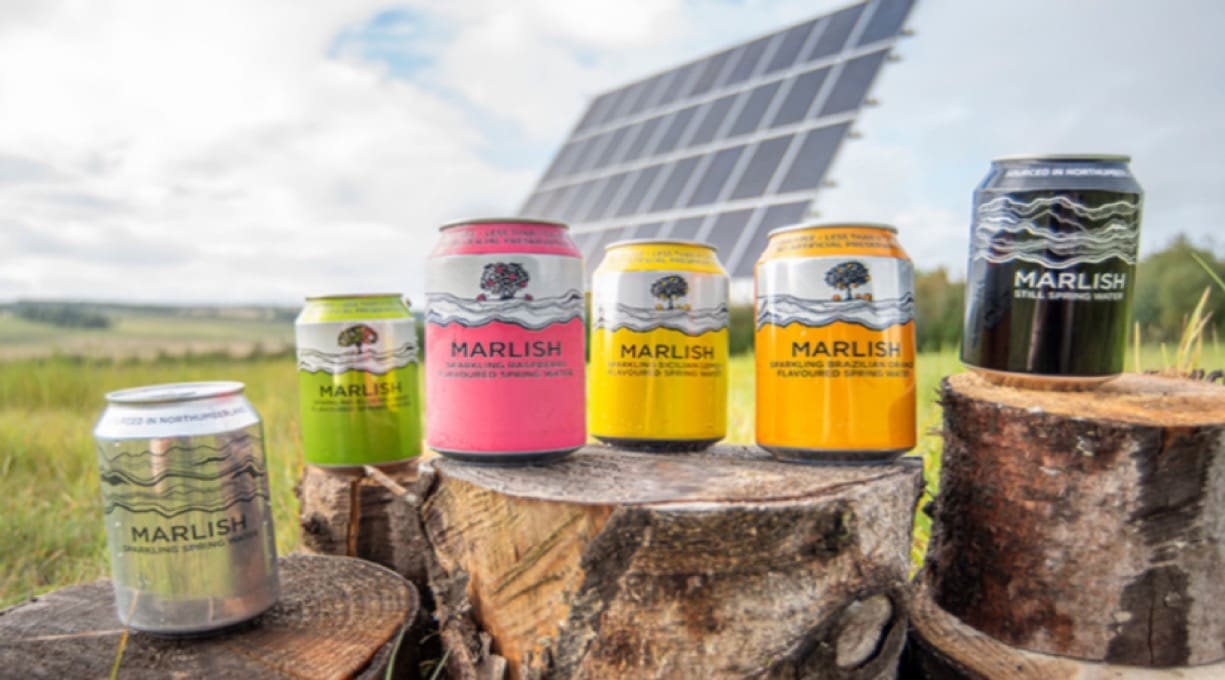
In 2015, Marlish Farm became the first fresh-water spring to package its wares in aluminium cans when all others were using plastic bottles. Driven by the desire to do right by the environment that supplies their income, the pair found a niche in doing things differently, doing things a little more sustainably.

“We use an aluminium can supplier based in Carlisle,” Joe Evans tells us. “They’re 48 miles up the road from us, you couldn’t find one much closer than that. It’s part of everything we do to keep our carbon footprint down.”
Today the headline news is that Marlish Farm has become 100% powered by renewable energy. Which is why this week, journalists, food bloggers, and current and potential supply chain partners can be found, within its fields, planting trees and sewing wildflowers in the name of #WorldEnvironmentDay.
One field in particular is dominated by the presence of a rotating solar panel. It’s this panel that supplies a full 15% of the farm’s energy to power its production. Through a partnership with Go Low Carbon and Pozitive Energy, Joe and Elizabeth have since realised their ambition to run Marlish Farm entirely on the power of solar, wind, and biomass. Oh, and the good, old-fashioned legwork of a farmer born-and-bred, of course.

Elizabeth Walton is true farming stock. Stepping back from a career in teaching to pick up where her father left off, Elizabeth has seen Marlish Farm through a period of transition. It was once an educational farm that welcomed some 40,000 visitors a year but when its resident livestock were lost to Foot and Mouth in the early 2010s, Marlish was forced to diversify. Then, in 2013 when Elizabeth discovered that the fault line of fresh water running 90 metres below the countryside upon which her farm sits could be bottled and sold, it set a new course for the Marlish name.
Her cousin Joe, who handles the production side of the business, will tell you its discovery was luck. But observing just what the pair have built out of it, it’s hard to believe it was anything other than fate.
When she makes one of her infrequent and sporadic appearances of the day, taking time from running the show itself at Marlish, we’re eating a spread of stuffed vine leaves with cabbage and lemon salad. It’s been brought in, on this occasion, from a Newcastle restaurant called Magic Hat, an establishment which has put itself on the map for transforming local food waste into restaurant quality dishes of the day.
As a metaphor, it’s wonderful. Very little goes to waste at Marlish. All cardboard is collected and stored for recycling and all its aluminium cans and glass bottles come from reputable – and responsible – sources. What is currently single-use (the cello wrapping around palettes of product) is being phased out. Even the packing shed has been constructed from scraps found around the farm, while Marlish’s new bottling machine is a Guinness factory cast-off.

“I think we’ve used every last piece of reusable material around the farm to put the operation together,” says Joe. “All our cardboard is recycled and all that run-off water you see there, that all goes back to the land.”
The land Joe’s talking about is the little over 25 acres of arable farmland and a wildlife corridor that runs through its middle like a river of green. Elizabeth can reel off each of the species of trees lining it, and well she might, she’s planted each of them by hand for the past 20-something years, after all.
She plants them as part of a Marlish Waters customer tree-planting initiative the company is running. But you can tell that – initiative or not – she’d plant them regardless.
“I’ve always grown things,” she tells me. “I grew up growing my own vegetables. My brother and I would set up a stall selling our potatoes and when I was older, I started taking the chicken eggs to school and selling them there. Growing food and plants has just always been a part of my life.”

By extension of that, so has seeing the value in natural capital. Elizabeth has cornered a section of one field off for planting corn for local wildlife to nibble on and because of her tireless efforts Marlish Farm is somewhat more than a business operation but 25 acres rich in biodiversity. I ask Elizabeth if she has an ultimate plan for all trees she continues to plant – arranged in lines so straight you could run a ruler down them.
“Well,” she considers. “We’ve got a lot of Birch trees, so eventually we will start tapping them for birch water.” That could open new doors for Marlish Waters to diversify into other markets for its natural products, health and beauty being one possible avenue.
Not that the pair are in any hurry to expand the business. Environmental regulators have capped the water extraction rates from a single borehole for business at 20,000 litres a day. Currently, Marlish is tapping 5,000 litres a day – leaving room for some significant business growth should the team choose to ramp operations up. However, after a day spent in the company of the business’ two founders you sense – at least for now – that this isn’t the plan.
Marlish Waters is a celebration of nature. And if it can maintain that purpose at the centre of its operations for generations to come, there’s no reason it’s water couldn’t be enjoyed another 150 years from now.