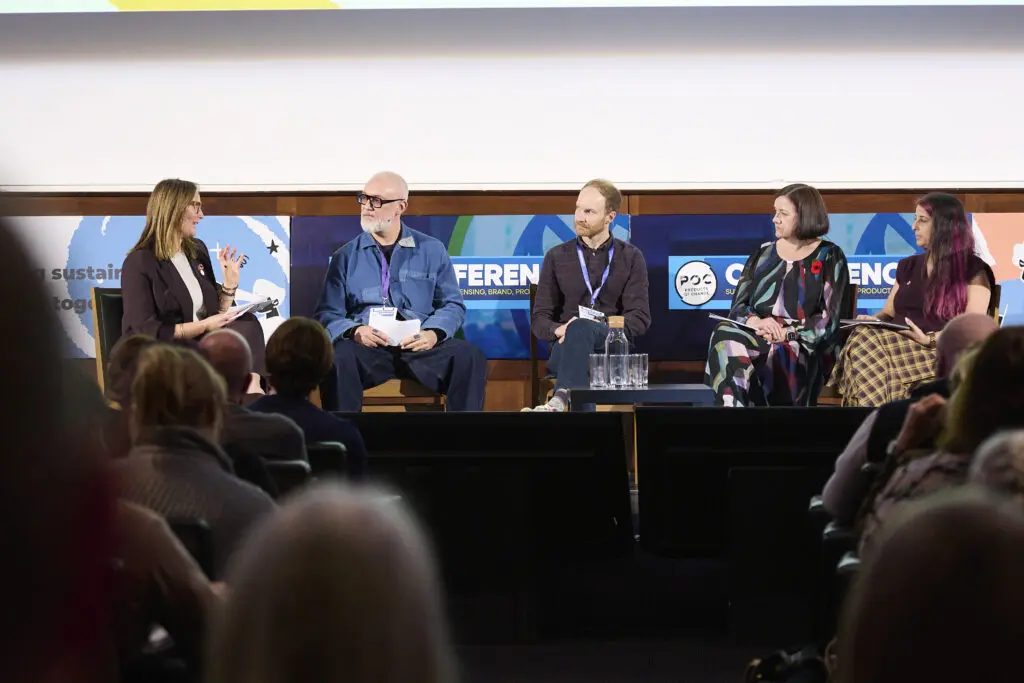
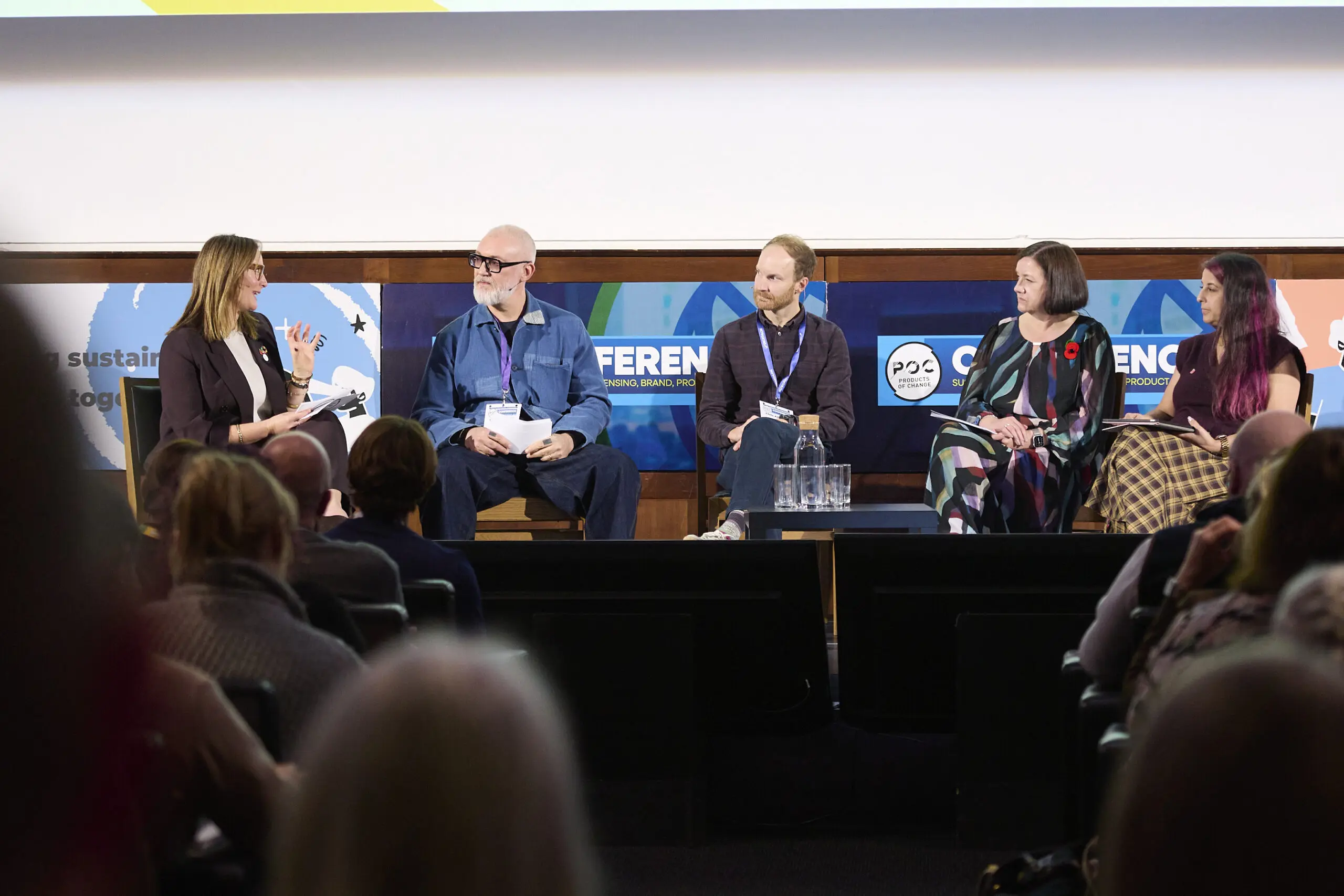
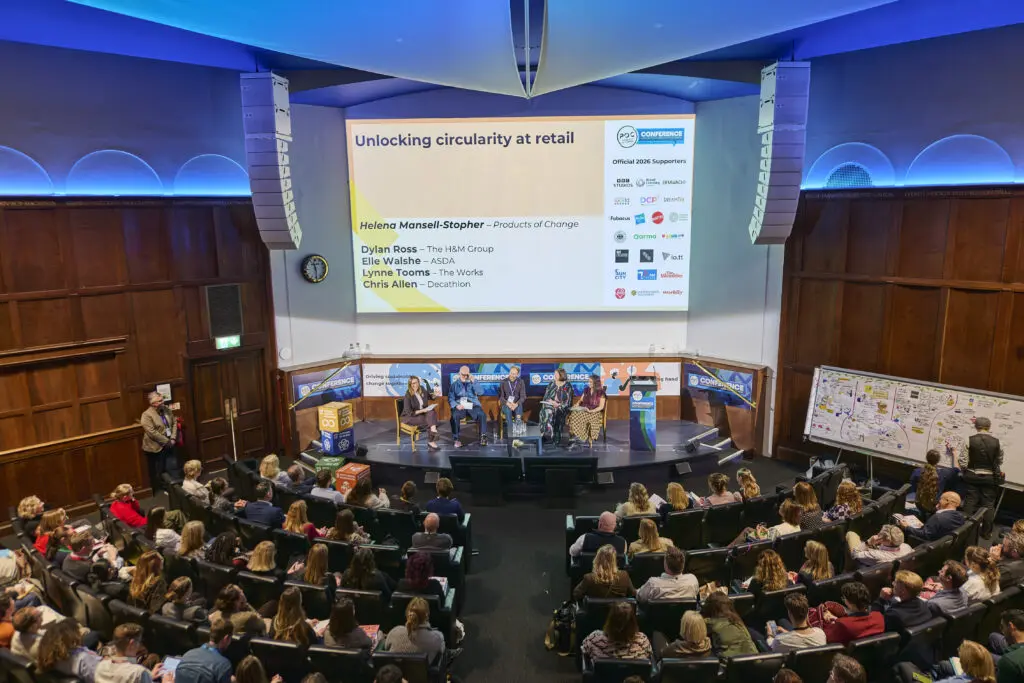
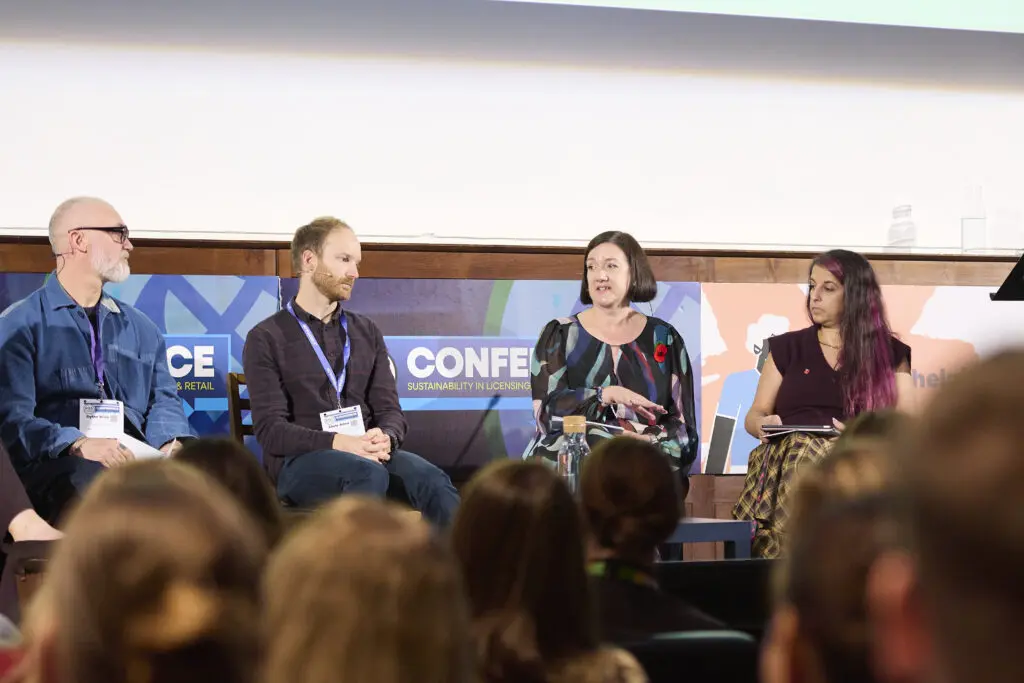
At the POC Conference last week, a standout session was the retail panel, where leaders from The Works, Decathlon, Asda, and H&M joined Helena on stage to share their journeys.
This session came about from POC’s retail working group, of which each of these companies are members. They regularly come together to share in closed environment the challenges they have. From this, the group is working together with POC to build a framework of how we need to work together as an industry to build circularity.
Dylan Ross from H&M began by sharing how there is a new department set up that he is a part of it which is responsible for building a framework to get more visibility of H&M’s supply chain and its product waste.
Chris Allen from Decathlon, who presented earlier in the day, explained how Decathlon has been building a business case for sustainability.
“The biggest challenge was the perceived risk of used products diminishing sales of new products,” said Chris. “We are reaching new consumers and as soon as you can show that it is having a positive impact on consumer spend […] you can easily see the huge value creation of circular services and that it has a huge benefit on the wider business.”
He added that it was a huge journey to show this and data was a big part of it.
Dylan continued that to undertake such work requires cohesion: “nothing works in isolation [..] all the departments have to work together to ensure we can scale it and make it work seamlessly.”
On the commercial side, Lynne Tooms from The Works spoke about how, for them, they had more agility as The Works is a “small organisation so we can join dots more easily.”
Lynne is also part of the operations board, so she has full visibility of P&Ls. “I can see regulatory costs that the buying team can’t and that was a gamechanger in the switch in how we talked about it as a team.”
Elle Walsh from Asda shared the work she has been doing on deadstock, collaborating with New Life charity, through which Asda has donated half a million boxes of product.
She is looking at how to enable resale of deadstock, but the time it takes to get approval is currently a barrier.
At Decathlon, Chris explained that there is something of a lack of red tape and it is not a particularly hierarchical organisation so “Change comes through quick,” such as the designers’ mandate for repairability.
The conversation then moved onto legislation, where Dylan spoke about how regulations are all well intentioned leg and moving in the right direction but not aligned: “the destination is the same, but the route is not aligned.”
He continued: “if we are having to use more recycled fibres but also asked to make more durable garments and strictly follow a waste hierarchy which means we have to resell and reuse before we recycle, this doesn’t necessarily go hand in hand so where do you prioritise?”
H&M sees legislation as benchmark, and has also had the opportunity of sitting with legislators to bring input from the ground and discuss what is workable from a retail point of view.
“There needs to be stronger collaboration between retailers and brands to share understand learn and develop,” Dylan added.
Chris also spoke to the importance of collaboration. Decathlon has been working on recycling systems but has encountered challenges when to comes to product complexity and the numerous materials involved in each. At the minute, the infrastructure just isn’t there for complete end of life recycling, which is where collaboration is key – “how can we as an industry understand that after a product is at its end of life, how can we recycle it and build onshore or nearshore recycling infrastructure in the UK? […] Collaboration is the biggest part of moving to the next stage.”
Likewise at The Works, Lynne shared how her sustainability team worked with the buying team to implement the change needed.
She purported that it needs to be real for the buying team, “they are the only people who can make a difference here.”
The Works held workshops for the buying team, focusing on simple to understand language to highlight the impact of legislation and regulatory costs which need to be considered in the product development stage.
As a result, the buying team took ownership and were proud of the changes they had been able to make to product. Sustainability needs to be integrated, not just sit as a separate process.
Meanwhile, Elle discussed how Asda launched an outlet on eBay in Sept 2025 and has since sold over 18k products, despite never marketing or speaking about it as a business; it was all organic resale of general merchandise.
Asda is working on launching the same initiative on the apparel side, which is in testing, but has different challenges to general merchandise because of the advent of super-fast fashion retailers such as Shein and Temu which mean there is a limit on what people are going to pay. They are exploring a get around with this by offering product bundles, eg school wear in an age bracket to make it more valuable for the consumer.
Asda is still doing everything, but everything is behind closed doors as not ready to talk about it without being called out, explained Elle, after its recent CMA challenge.
H&M is also working on its end-of-life strategies: “Our team has a tagline that circularity doesn’t begin when a garment becomes waste, it begins when the garment is created,” said Dylan.
He added that work is needed to destroy assumptions that all garments can be recycled; they can’t, they must be constructed in that way. Print and its application has to be heavily considered.
Chris explained that for all the work to take place, investment in circular teams is so important. A lot of focus went into the behavioural change to educate teams on the shopfloor.
In a concluding note, Helena asked the panel what is needed to move sustainability forward in retail – and there was a resounding consensus: collaboration. They all agreed that sustainability should not be seen as a competitive advantage and they everyone should be collaborators in that space: “We will only make a difference if we collaborate and move forward together with consistency.”