To wrap up the POC Conference, we finished with our Innovation Spotlight.
At Products of Change, we have been exercising our leadership in bringing innovations and innovators into the POC Community, showcasing them to the industry as solutions that there and ready for the taking.
To do this, we have worked in close partnership with The Mills Fabrica, an innovation accelerator hub for material and agrifood solutions, particularly targeted towards sustainability. Based at Kings Cross as well as Hong Kong, the team have kindly hosted us for a number of our Member events as well as introduced us to some incredible innovators, some of which you will see here today.
As well as through our Member events, the theme of innovation spotlights has been woven into everything we have done this year, whether it be our on-stand showcases at Licensing Expo and BLE, our webinar content, or our Editorial Chapters.
This year, we had our biggest ever line-up of innovators at the Conference, and their presentations were just the best way to end a day of future-focused discussion, ambition, and now awe-inspiring solutions.
We had seven innovators lined up: BioFluff, io.tt, James Cropper, DyeRecycle, Baneco, Arda Biomaterials, and Balena.
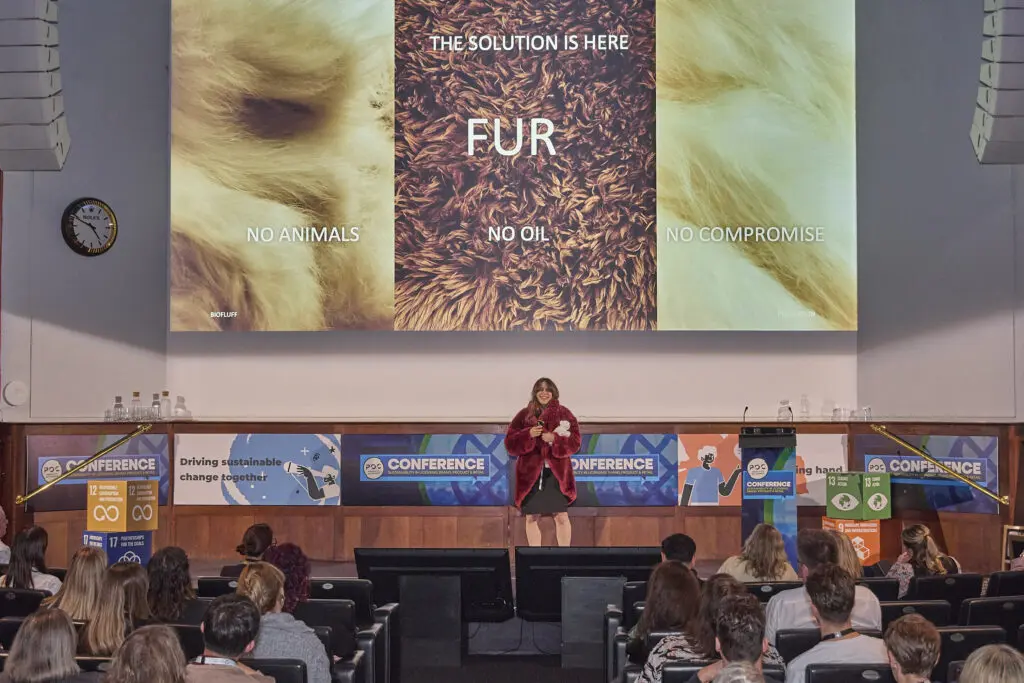
BioFluff: Roni GamZon
“We are on a mission to reinvent fur,” began Roni who first came to the Conference two years ago to debut her innovation.
BioFluff is made with no animals, no oil, and no compromise, with its beginnings in the fashion space, working with brands such as Stella McCartney and most recently Louis Vuitton.
Roni explained that it was the POC Conference two years ago when she had her first interaction with the toy licensing industry, she had just had a new niece and knew that BioFluff couldn’t stop at fashion, it had to expand to toys.
Plush is a super shedder of microplastics, shedding more than three times the amount of non-piled textiles, which is both harmful to the planet and human health.
But BioFluff has its fully ready solution which is free from harmful chemicals, entirely made from plants, recyclable, biodegradable, and compostable.
BioFluff has been working with industry through POC working groups to understand the differences and needs of the toy licensing space. And now the material is completely ready for industry and at scale, with production capacity of over 50,000 meteres per week.
The material is low carbon, low flammability without the need for flame retardants, industrial compostable, and hypoallergenic.
Roni finished with a call to action for the industry to work together on mass scale adoption. It still costs a premium but need everyone to work together to lower prices and provide healthier products for animals, people, and the planet.
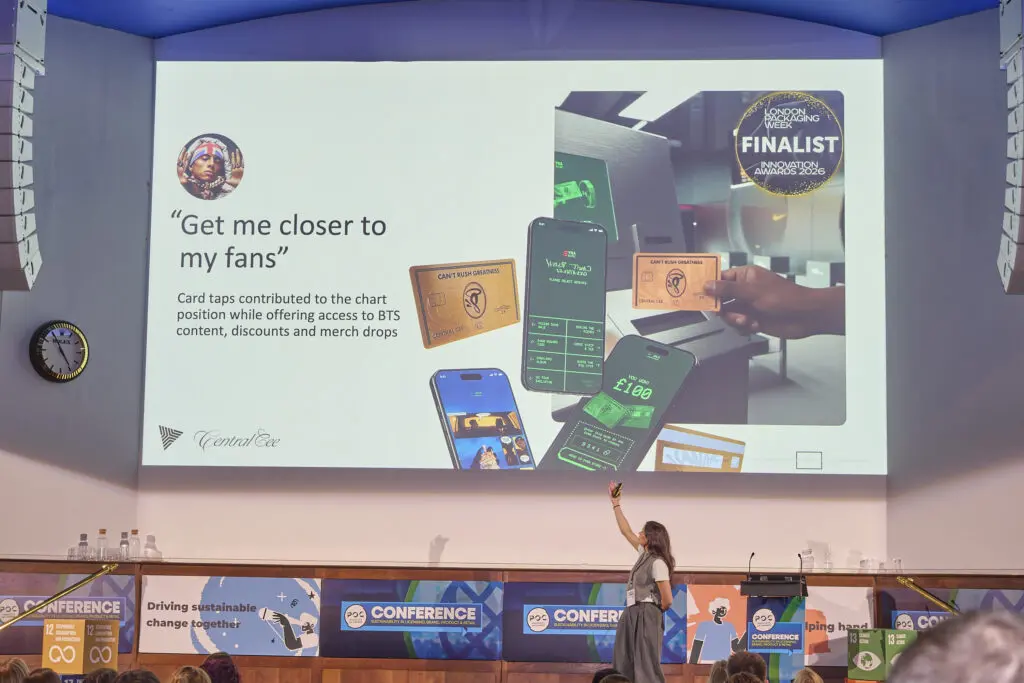
io.tt: Laura Sturgess
io.tt is a connected products platform, which originally focused on consumer engagement and data acquisition but is shifting to compliance and sustainability.
It has connected over 4bn products with NFC and QR codes across different sectors such as sport jerseys, fashion, beauty, and food and beverage.
io.tt can help manage the creation of QR codes, creates engagement experiences, and uses data to learn from everything, such as who is using product when and where, what product is doing best and what do consumers want to know.
52 years ago, the barcode was adopted, saving time for retail, but from next year, every product you sell will have to have a QR code on them, which can host a lot more information.
It does more than go beep at the till, explained Laura, it can help communicate and turn products into a media channel. Connected packaging allows you to get compliant, be accessible and provide recycling information.
But it needs to be engaging; compliance not often sexy but it can be, said Laura, especially when it is developed as an extension of the brand identity and encourages engagement. Connected packaging can enable fun consumer marketing and lead through to storytelling.
It is part of the next generation of products that are moving towards compliance, engagement and accessibility.
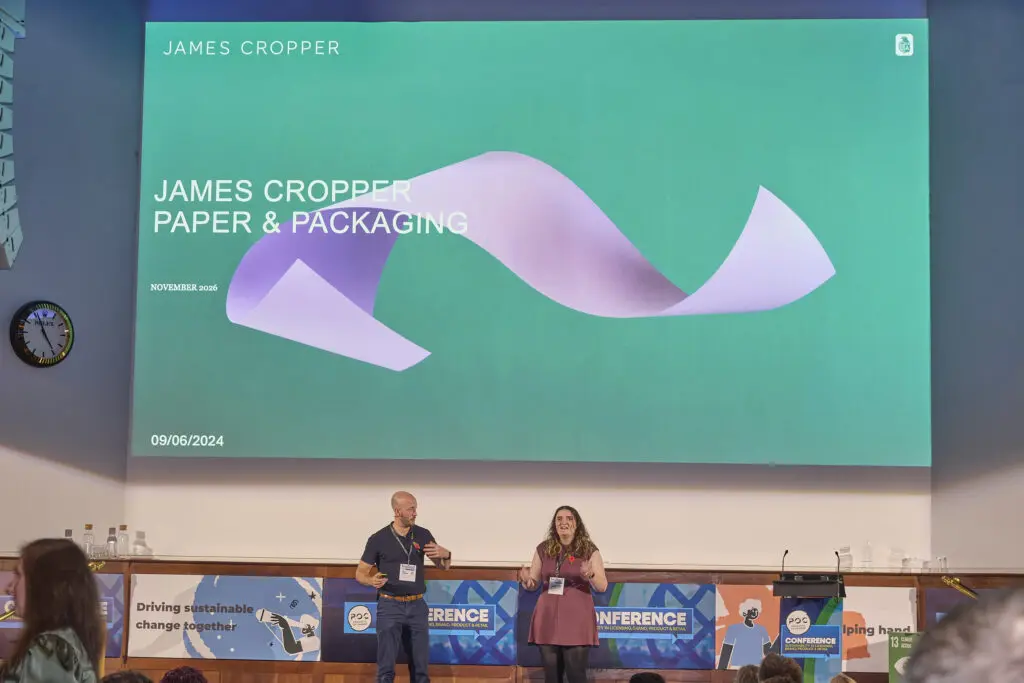
James Cropper: Josh Holland and Genevieve Scullion
A major UK paper supplier, James Cropper supplies poppy paper to the Royal British Legion, and is the largest supplier of book binding cover papers in the UK.
But the team were there to talk about their ten-year innovation coming to the forefront – recycling coffee cups.
The James Cropper factory is based in the Lake Distruct on a protected river “so sustainability is part of everything we do,” said Josh.
At the minute, coffee cups are thrown into landfill, which is high quality fibre but it needs to be separated from its plastic liner to be useful.
James Cropper collects cups, ensures they are a suitable grade, and puts them through its chemical process to strip the PE lining and recycle the paper fibres. The waste plastic is used to make garden furniture by a local company in Cumbria.
“Most recycling streams don’t achieve 100% recycling waste, but we can here,” said Gen.
Currently, Croppers recovers 200 millions cups recovers, but it has the capacity to do 750 million – the biggest challenge is collection, which is a circularity gap.
It is important to manage the raw material supply as there are different types and compositions of coffee cups; people don’t know what they’re made up of. But it is bleached paper fibre that is needed with the PE lining, any others contaminate product streams, which emphasises how important it is to know your supply chain.
Croppers works with companies to get its coffee cup fibre into products such as greeting cards, notebooks, and Happy Meal books in Germany. It is here to help brands, licensees, licensors develop sustainable packaging and paper solutions.
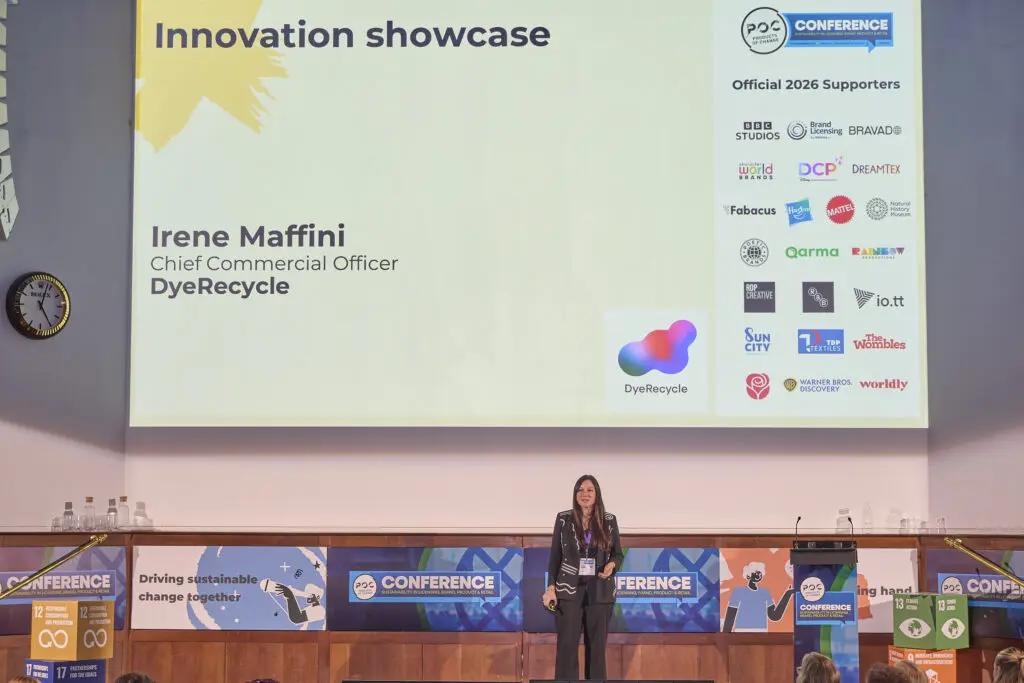
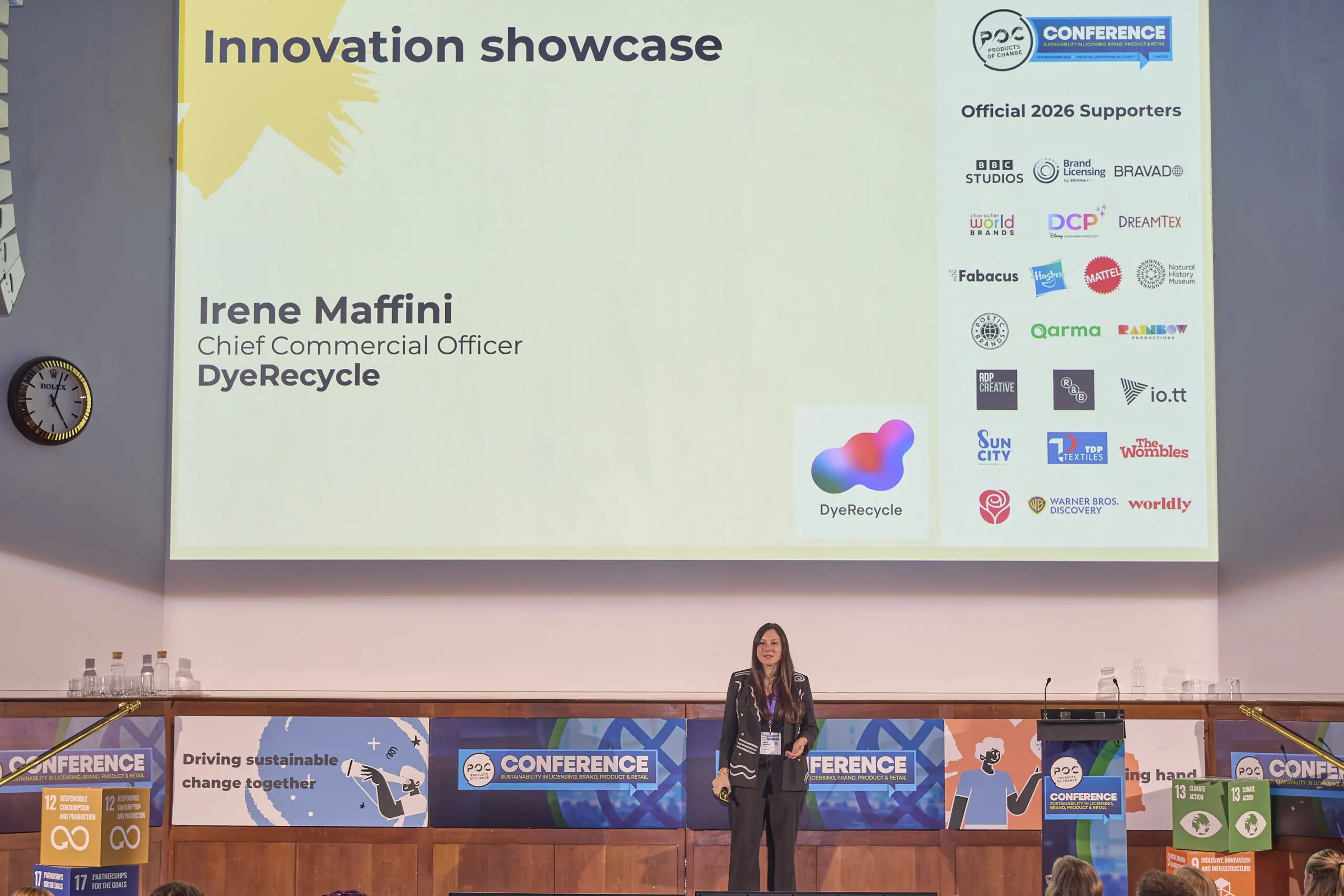
DyeRecycle: Irene Maffini
“Polyester is everywhere,” began Irene, and when it comes to recycled polyester, the chances are is it came from a PET bottle, not previous polyester fabric. “This is not good enough,” said Irene, “we need to move forwards.”
DyeRecycle is solving a big challenge in textile-to-textile recycling of polyester: 98% of recycled polyester comes from bottles, but bottles should be in a closed loop.
Less than 1% of all fibre comes from recycled textiles, largely because most chemical recyclers do not touch post-consumer waste. Unlike PET bottles, 92 million tonnes of textile waste is unrecyclable since textiles have colours and finishing chemicals to give them desirable properties, and they’re often blends – essentially creating something that cannot be recycled.
DyeRecycle is an offshoot from Imperial College London, and it has developed a solvent that can strip out dyes and finishes from textile waste to produce white pellets that can go back into filaments, in a closed loop where the solvent is recycled.
DyeRecycle licenses its technology to textile recyclers and is working with largest groups in fast fashion and textiles to demonstrate that it can strip out most colours. It can also be integrated into existing polyester plants.
It is in an exciting stage of growth, said Irene, with a plant launching in Scotland next month and it is looking for new partners that want to recycle their own waste to enable textile to textile recycling.
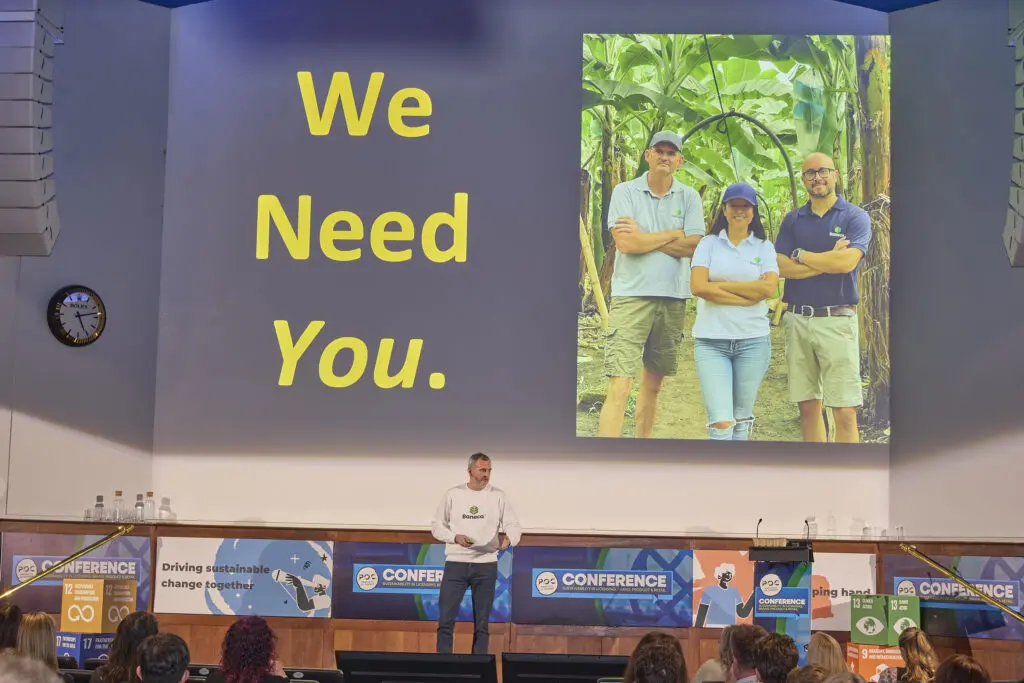
Baneco: Richard Edwards
“Everybody loves bananas,” started Richard, and we eat a lot of them. But the residue ratio 4:1, which means for every tonne of bananas produced, there are four tonnes of agricultural residue, “which is very exciting if you’re in the materials industry,” said Richard.
This includes two types of feedstock which Baneco uses: stalk and trunk, which are otherwise not used at all. The banana plant only fruits once, it takes 9 months to grow then it is chopped down and left to rot, releasing methane into the atmosphere.
Using this waste material means no new planting, virgin fibre performance, and the fruit carries the farm footprint and the primary output, making it a naturally regenerative, naturally low carbon material.
Baneco was launched in 2023 to cut plastic use and create new income streams for farmers worldwide, who are being squeezed by the falling price of fruit and the impacts of climate change. For vulnerable communities, it creates economic value.
There is a billion tonnes of resource available year round, currently discarded, a resource that is rich in properties that make it desirable for packaging and with over 80% lower carbon footprint.
Baneco has started with egg trays and other fibre moulded packaging such as coffee cup trays, and packaging inserts. Its next generation is food contact trays with bioplastic liner which will be recyclable, solving a current challenge with this format.
A partner it works with previously used recycled paper and card which is a volatile feedstock, but its switch to Baneco’s fibre has meant a better fibre performance and therefore a better end product. It comes ready to use to put into paper machine.
Richard said what they need is for brand owners and retailers to pull material through their supply chain; “when you talk, your suppliers listen and your suppliers’ suppliers listen.”
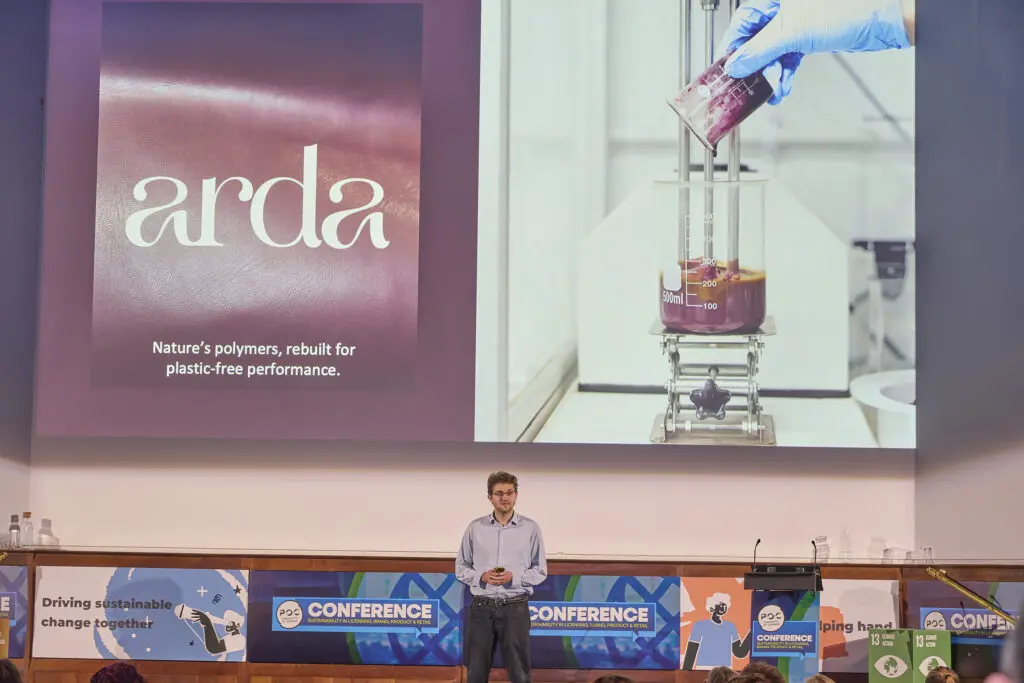
Arda Biomaterials: Brett Cotton
Arda Biomaterial is a new kind of chemistry company for the 21st century, creating new materials from plant proteins rather than barrels of oil, said Brett.
Big chemicals companies today started in the 1950s with petrochemicals, but before that there was a world before plastic.
Rather than creating a petrochemical polymer, Arda has created from abundant plant proteins, by taking byproducts from industry that are rich in plant proteins that mimic collagen.
The resulting material can be used to replace plastic like PU. It can also be spun into fibres, foams, adhesives, and other solutions. But Arda is starting with one main product: New Grain, a non-woven textile which serves as a leather substitute, performing like animal leather as it is made from proteins, but can scale to volumes of synthetic. It is also customisable for mechanical performance, aesthetic and hand feel.
Arda is exploring exciting feedstocks, such as brewing which leaves behind barley and sugar; spent grain is 25% protein making it an ideal source. And it is very abundant; Brett explained that if Arda worked with just one major brewery, it could create four million sq ft of material from just one brewery site. It is also a very quick process, with the potential to transform spent grain into material in less than 24 hours. It also uses exisiting manufacturing systems.
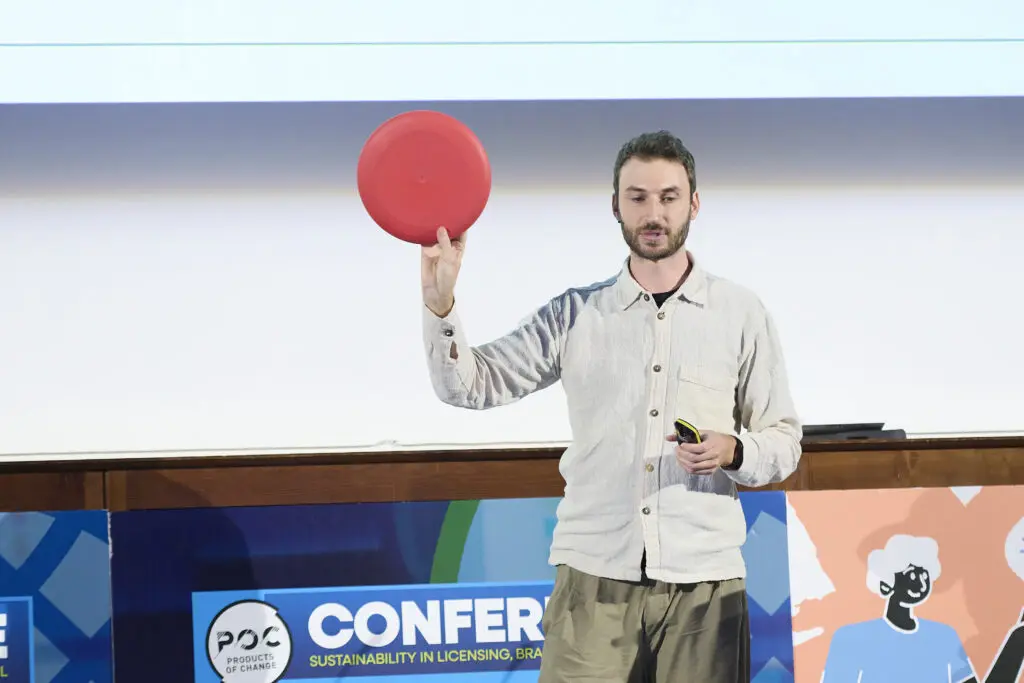
Balena: Miles Gibbons
Our current linear product system results in 80% of toys ending up in landfill or incineration, according to Ellen MacArthur Foundation. But Balena uses a biological cycle rather than technical cycle for its material, utilising biomass to make products, to then use biological processes at end of life as waste management.
“Plastic is one of the most amazing materials,” said Miles, “The problem was never plastic itself but how the industry made it, used it, and disposed of it.” So Balena creates biopolymers that are biodegradable.
It works with big brands and suppliers to make durable materials for the modern day.
Most are based on BioCir: bio-based, biodegradable and pre-consumer recyclable so no factory waste
- BioCirFlex – for footwear industry
- BioCirFoam – same base polymer to reduce impact of injection foaming materials
- BioCirXT – rigid plastic alternative, eg buttons, frisbees
It is a cutting edge materials in bio based and biodegradable space, it can be made in any colour, and it is ready, scalable and safe, while working in existing supply chains.