
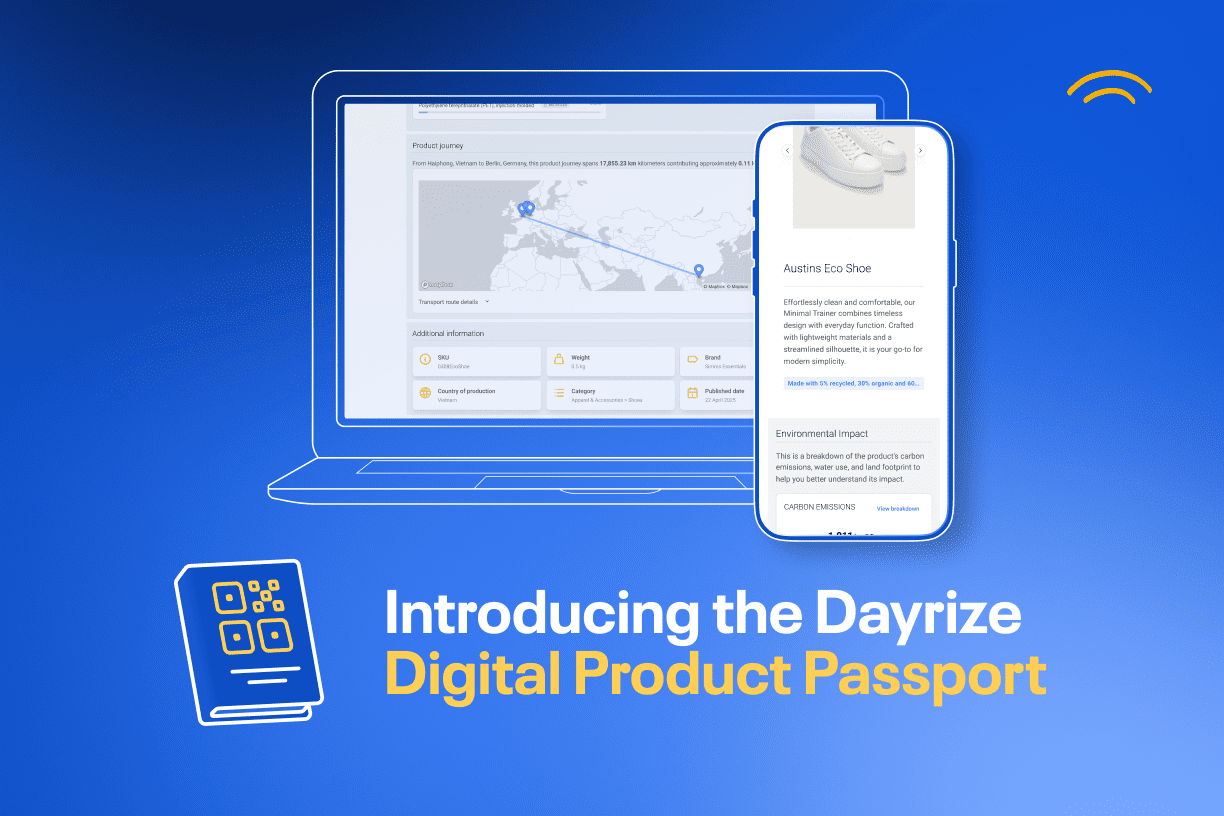
POC member and partner, Dayrize, has launched its own Digital Product Passport (DPP) for every product type and category, in alignment with EU regulations, and slotting into its existing data collection and compliance software.
Part of the EU’s Eco-design for Sustainable Products Regulation (ESPR), the DPP serves to provide customers with detailed insights into a product and its environmental impact. Dayrize has developed DPP capabilities to extend its current data collection offering and provide the passport all in one place.
“With our new DPP product, compliance is literally one click: we take the rich product and impact data we already collect for every SKU, automatically generate a fully certified passport, and serve it up through a simple QR code or shareable link. No extra surveys or a third-party patchwork of different software providers required,” commented Austin Simms, founder and CEO of Dayrize.
Dayrize offers two DPP options: a fully-fledged passport that is created for companies by Dayrize, and a partial solution which provides all the data though an API for a company to create its own DPP, depending on preference.
As the deadline of DPP adherence looms ever closer, there is some reluctance by some organisations to adopt the passport over greenwashing fears due to less-than perfect data. However, Dayrize has automated data capture within its software, and the ability to have suppliers and different teams along the supply chain utilise the system to improve the primary data across all product types and keep it up to date.
Dayrize’s DPPs include essential product information such as materials used, country of origin, certifications, and the environmental impact across water and carbon. When the product data is updated, the passport is also automatically updated so will always have the most current information.
This means as regulations are updated and different data points are required, by EU legislation for example, the passports can adapt accordingly, since there is still some ambiguity as to what the DPP requirements will be.
“We didn’t wait for perfect clarity – we moved early and decisively. When EU guidance on Digital Product Passports was still evolving, we zeroed in on the model the European Commission itself would later endorse: a federated, service-provider-based system,” explained John Kirwan, VP sales, Dayrize.
“We weighed the full picture – cost, control, speed to market – and rejected the clunky, centralised approach and the high-burden manufacturer-hosted model,” John continued. “Instead, we built a DPP solution that’s fast, flexible, and future-proof: machine-readable, QR-code linked, and ready to plug into the upcoming EU DPP Registry and Web Portal.
“It’s built to scale across sectors – textiles, furniture, construction, electronics – and already aligned with BIM, CSRD, and circular economy goals. Our strategy? Get ahead, stay agile, and turn compliance into competitive edge. Now we’re not just meeting the rules – we’re helping define what good looks like.”
Dayrize is anticipating its DPP launch will encourage its customers to not only upload more data, but more accurate data, as it will be more readily visible, therefore encouraging transparency and building trust with partners.
Click here for more information on Dayrize’s DPP.