

The thing I took away from New York is that the conversation has moved. Two years ago the question was whether any of this was coming. This year nobody asked that. They asked how long they have, and what they should start with.
By Güneri Tuğcu, global director partnerships & ecosystems, r-pac International.
On the Tuesday evening of Climate Week I ended up at a poker tournament in Midtown where the buy-in was carbon credits. Every chip on the table was a metric ton.
By the door there was a board explaining what each denomination actually buys. One ton is a return flight from New York to London. Fifty tons is twenty shipping containers crossing the Atlantic. Five hundred tons is roughly one person’s entire lifetime footprint.
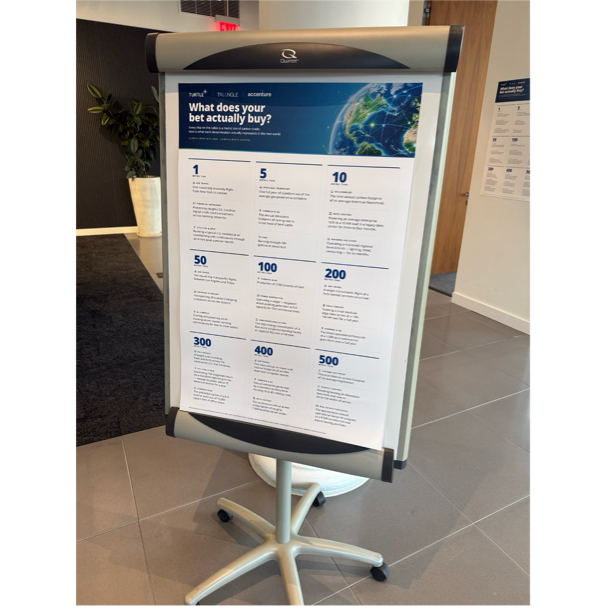
I watched a lot of people stop and read that board properly. These were people who work with carbon numbers for a living, and most of them could not have told you beforehand what a ton looks like in the real world. The abstraction had been sitting in their spreadsheets for years without ever becoming a thing you could picture.
That stuck with me for the rest of the week, because I kept running into the same problem in a different form.
Everyone wants product-level data. Almost nobody has it.
My week ran across a lot of rooms that do not normally sit together.
Monday was the AAFA Textile EPR working group, hosted at BlueCherry’s offices in Brookfield Place, where the conversation was policy and what compliance will actually require. Later that day I was at Columbia for Powering Forward, on sustainability in sports and entertainment, which I had not expected to be one of the highlights and was.
Speakers came from major venues and clubs, and a lot of the discussion was about super-fans and what a jersey could be if it carried more than a badge. Your season pass, your wallet, your ticket, your proof that the shirt is real. That is the connected consumer conversation arriving from a completely different direction to the one I usually come at it from, and the audience was clearly interested. Sport tends to reach this sort of thing before fashion does, because the emotional attachment to the product is already there.
Tuesday morning was traceability and nature-positive supply chains at Tapestry’s headquarters in Hudson Yards, hosted with WWF. Textiles, circularity and policy in one session. That afternoon I was two minutes down the road at the Global Turks Forum at META, with a very different crowd of investors and industry leaders. It was a useful change in perspective before heading into an evening with Triangle and Turtle, and the poker.
Wednesday was the full day at Accenture’s offices at 1 Manhattan West, hosted with Triangle, Howden and Schneider Electric. Panels ran from AI and the infrastructure squeeze, through insurance as an accelerator, to Article 6 and carbon markets.

I joined the session on turning supply chain data into business value, alongside Rosemarie Miner of OurTemenos and Shpend Ahmet of Data4X, moderated by Mike Dieterich of Triangle. We also brought connected products onto the main stage that morning. In a week full of conversations about data, there was something useful about making the link between a physical product, its identity and the data behind it tangible.

Thursday started with a roundtable on resale, repair and digital IDs, with people from Coach, eBay, the Ellen MacArthur Foundation and Circulose in the room, then a coffee meetup hosted by Alante Capital, which put investors in the mix.
Policy people, brand people, insurers, investors, technologists, resale platforms. Very different rooms, and the same gap in every one of them.
Everyone now accepts that the interesting questions are at product level.
What is this actually made of?
Where did it come from?
What happens to it after someone has finished with it?
Extended producer responsibility asks those questions. Resale asks them. Carbon accounting asks them. So does anyone trying to prove a claim rather than simply assert one.
And most supply chains still struggle to answer them at the level of an individual item, because they were built to identify styles, SKUs, orders and batches, not necessarily the individual physical product.
That distinction sounds like a technicality. It is the whole thing.
If you can only identify a model, much of what you say about a specific product is still derived from an average or a batch rather than that individual item. Your footprint figure may be an average. Your material claim may come from production-level data. If something goes wrong, the more precisely you can identify the affected products, the more precisely you can respond.
The jump that matters
There is a ladder here and it is worth being honest about where most of us are on it.
At the bottom, products are not uniquely identified at all. One step up, you can identify a style or an SKU, which is where much of the industry still sits today. The step above that is item-level identity, where each physical unit carries its own unique, resolvable identifier. Above that sits traceability and compliance data connected to that identity, and above that the things people actually get excited about: authentication, resale, repair, recycling.
Regulation is pushing the industry up that ladder. The commercial opportunity sits higher still. But the step I think matters most is the move from model-level information towards persistent product identity, because so many of the use cases above it become more powerful once you know which physical product you are actually dealing with.
That is also the step that takes time.
It is not just a software purchase. It means changing what goes onto the product on the factory floor and getting structured data to follow it through a supply chain that has never been asked to carry it before.
Maybe that is why the poker table stayed with me. A carbon number becomes more useful once someone can picture what sits behind it. Product data is not so different. The value starts when the data can be connected back to something real.
What I would say to anyone reading this
If you are working on EPR, circularity or environmental claims, the timeline you should be working backwards from is not only the compliance deadline. It is how long it takes to put the underlying product identity and data infrastructure in place.
The honest position is that not all of this is solved.
The physical side is much further along. We already know how to give products persistent identities through labels, tags and embedded technologies designed to survive the useful life of a garment. The harder questions increasingly sit around the data, who maintains the record once the brand has moved on, and what happens to identity when a product stops being a product and becomes material again.
A jacket resold is still that jacket. A jacket shredded into fibre is not, and nobody has properly agreed where identity goes at that boundary.
I would rather say that out loud than pretend the loop is closed.
But the direction is clear enough, and the thing I took away from New York is that the conversation has moved. Two years ago the question was whether any of this was coming. This year nobody asked that. They asked how long they have, and what they should start with.
Start with one collection. Serialise it properly. Find out what breaks.
Everything you learn there is what you would otherwise be learning in 2028 with a deadline behind you.