
Research charting the priority of challenges and concerns being faced by parents and families across the world has highlighted the importance of the continued pursuit of the 17 Sustainable Development Goals as established by the United Nations and presented as the blueprint to achieving a healthy and positive future.
In his latest piece of industry-leading insight, Gary Pope – co-founder of Kids Industries – shared results that found environmental concerns to have slipped down the list of priorities for families around the world who now place fears over income and cost-of-living; safety, security, and crime; and disparity in education and equality ahead of the topic of climate change and pollution.
Presenting findings taken from the insight experts’ latest Global Family Study – a study that gathered data from over 5,000 families from across ten countries around the world – to an audience of Products of Change members this week, Gary argued the need for better engagement from the toy and brand licensing industry with young people and families when it comes to the subject of sustainable development.
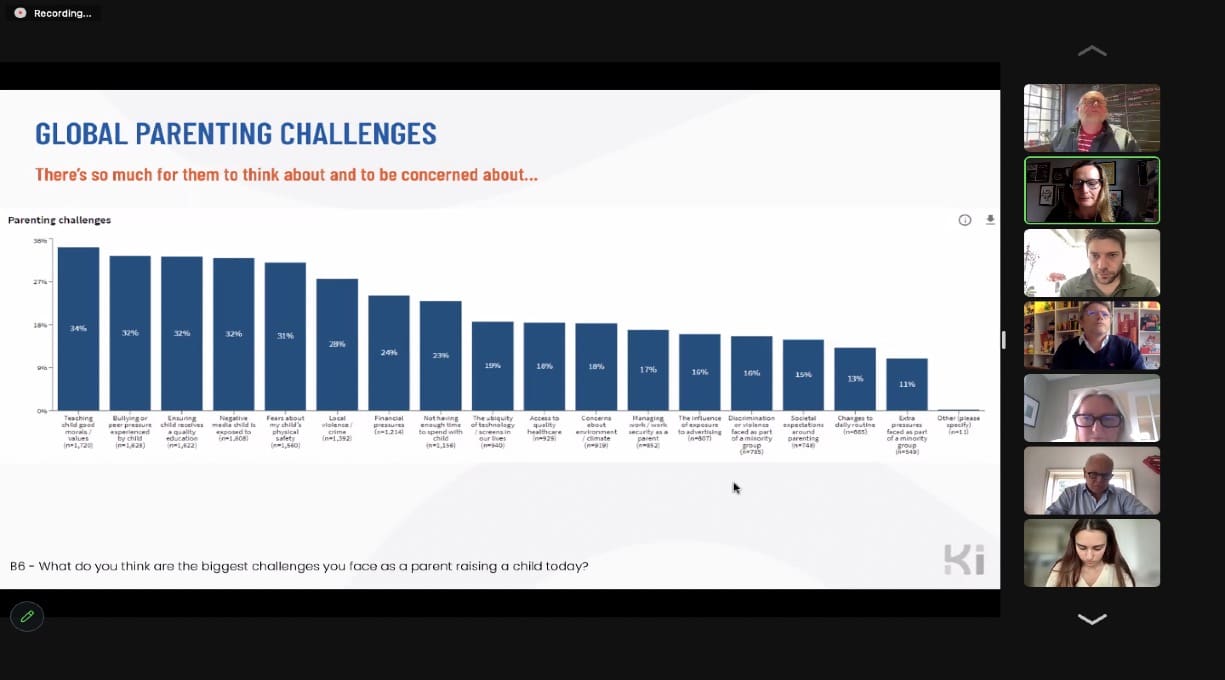
Among the issues topping the chart of challenges being faced by families around the world right now, ‘teaching good morals’ emerged as number one. At number two is the effects of ‘bullying and peer pressure’, while number three is ensuring that children receive ‘good quality education’. ‘Financial pressures’ place at number seven on the chart, while concerns around ‘the environment’ finds itself at a mid-table level at number 11.
“And why wouldn’t it?” Gary asked attendees the week. “These are things happening to families every day, not a big existential topic that seems out of reach, but lived realities.”
The reality of the situation when it comes to the engagement that 4 to 14 year-olds from across countries including the UK, the US, Brazil, Saudi Arabia, and China show in the subject of climate change was broken down further when Gary revealed that 58% of children in the UK do not know what ‘sustainability’ means. Comparatively, 47% of US children say they are confused by the messaging surrounding the topic, from environmentalism and sustainability to the concept of greenwashing.
Most problematic of all, however, is the study’s headline statistic that in 2023, 74% of children from around the world feel positive about the future. It begs major questions over the concerns and childhood being experienced by the remaining 26%.
“The fact that children have to think about this stuff, the fact that these pressures exist in childhood around the world makes me physically sad,” said Gary. Citing his role as Ambassador for Children for Products of Change, the former teacher-turned global research expert has challenged the industry ‘to harness its power better’ and help ‘activate and engage children.’
“The actuality of this is, children – Generation Alpha – are not the environmental activists that many seem to paint them as,” says Gary. “They do not understand the topic either because they are too young – the four to seven age range can’t really understand this topic itself – or because they are not empowered to do so.
“The truth is kids will carry on doing what children do – which is just to be kids. Which is great, which if fantastic, which is lovely. But these children also need to be activated and empowered in some way. And that’s down to all of us – to help that knowledge and learning element.”
Gary’s research noted that by the age at which young people are in fact empowered enough to act upon the issue – the age of 14 and upwards – is the age that their priorities are lost to the age of ‘teenager-dom’, in which social standing and peer perception takes precedent over all else.
But this all looks at the issue through a relatively myopic lens. While ‘the environment’ and ‘climate change’ may place only mid-way down that list of priorities for families in 2023, it’s important to observe the major parallels that can be drawn between current challenges and concerns and the over-arching blueprint of global sustainable development.
Headlines around the world perpetuate the importance of fighting climate change through the lens of greenhouse gas emissions and carbon reduction. However, sustainable development is an interdependent system that requires its building blocks – issues such as gender equality, quality education, peace and justice, sustainable health and wellbeing, zero poverty, and decent work and economic growth – each be elevated in unison. The system is built on the belief that by improving lives and education around the world, we improve our relationship with the environment and the planet.
And interestingly, the inefficiencies within in each of these areas are those being dealt with day-in day-out by parents and families around the world.
Gary promised at the start of his presentation this week that it “would pose more questions than answers”. He wasn’t wrong. But those questions themselves are empowering. How do we better engage children and families with the concept of sustainable development? And does the answer lie in meeting them at a level of actual impact – the lived experiences and challenges they face everyday?
Products of Change members will be able to rewatch Gary’s presentation via the On Demand platform later this week.